
Climate change calls for new standards and regenerative practices, notes SIC panel
Amid the effects of El Niño, experts detail ways to mitigate impacts on production and ensure sustainability
The immense challenges facing Brazilian coffee farming in the face of climate change—which are expected to intensify in the coming years—were the focus of a panel titled “Coffee in a New Climate: How to Produce Amidst Greater Climatic Instability?” during the International Coffee Week (SIC). The discussion took place early Thursday afternoon (12), the second day of the event, which is being held in Belo Horizonte (Minas Gerais) and runs through Friday (13).
Moderated by Alysson Fagundes, president of the Foundation for the Support of Coffee Technology (Procafé), the panel brought together several experts: José Donizeti Alves, a specialist in plant physiology at the Federal University of Lavras (UFLA); Nadiara Pereira, a meteorologist at Climatempo; and Farlla Gomes, coordinator of the Educampo Sebrae/Expocacer project, a platform that provides technical assistance to coffee producers.
Nadiara, who grew up in a farming family in the interior of Rio Grande do Sul, opened the discussion by highlighting the specific characteristics of the current El Niño—a climate phenomenon marked by the abnormal warming of the waters in the equatorial Pacific Ocean. Although Brazil has not yet experienced the same extreme heat and erratic rainfall seen in 2023—the final year of the previous El Niño cycle—she reminded the audience that the United States and Europe have already been recording record-breaking temperatures in the second half of 2026.
According to the meteorologist, the planet is currently seeing warming peaks exceeding 1.5°C—a level of extremity that, until recently, was not expected until 2050. El Niño is projected to reach its peak between November and December, likely leading to intensified drought in the north through January, irregular rainfall patterns across the country, and increased precipitation in the south. “Due to the rainfall during this period, Arabica-growing areas have ended up with higher yields. However, states like Espírito Santo and Bahia have been hit harder, as has the Cerrado Mineiro region,” she stated. Overburdened Plants
Donizeti opened his lecture with a question directed at the audience: “Do you think the climate, moving forward, will be better, the same, or worse for coffee farming?” In the researcher’s view, there is a near-consensus: based on recent experience, climatic conditions are likely to remain at least as unstable as they are today—and will probably worsen. According to him, the effects of these changes are already evident in the flattening of the productivity curve for Brazilian Arabica coffee over the last decade.
He explained that extreme weather events often introduce an additional challenge for plants: the need for self-defense. Consequently, plants end up consuming up to 55% more energy—energy that should otherwise be directed toward fruit production—just to cope with these new climatic conditions. “Therefore, we must increase energy production so that the plants can continue to yield fruit without becoming exhausted,” he noted.
Excessive rainfall, hailstorms, and heatwaves that have affected coffee production in recent years also cause other issues. During months like January and December, for instance, plants have been absorbing up to four times more solar radiation than they actually require. “This energy is converted into ‘unclean’ energy, which leads to oxidative stress,” Donizeti explained, highlighting the toxic patterns that arise within the production process.
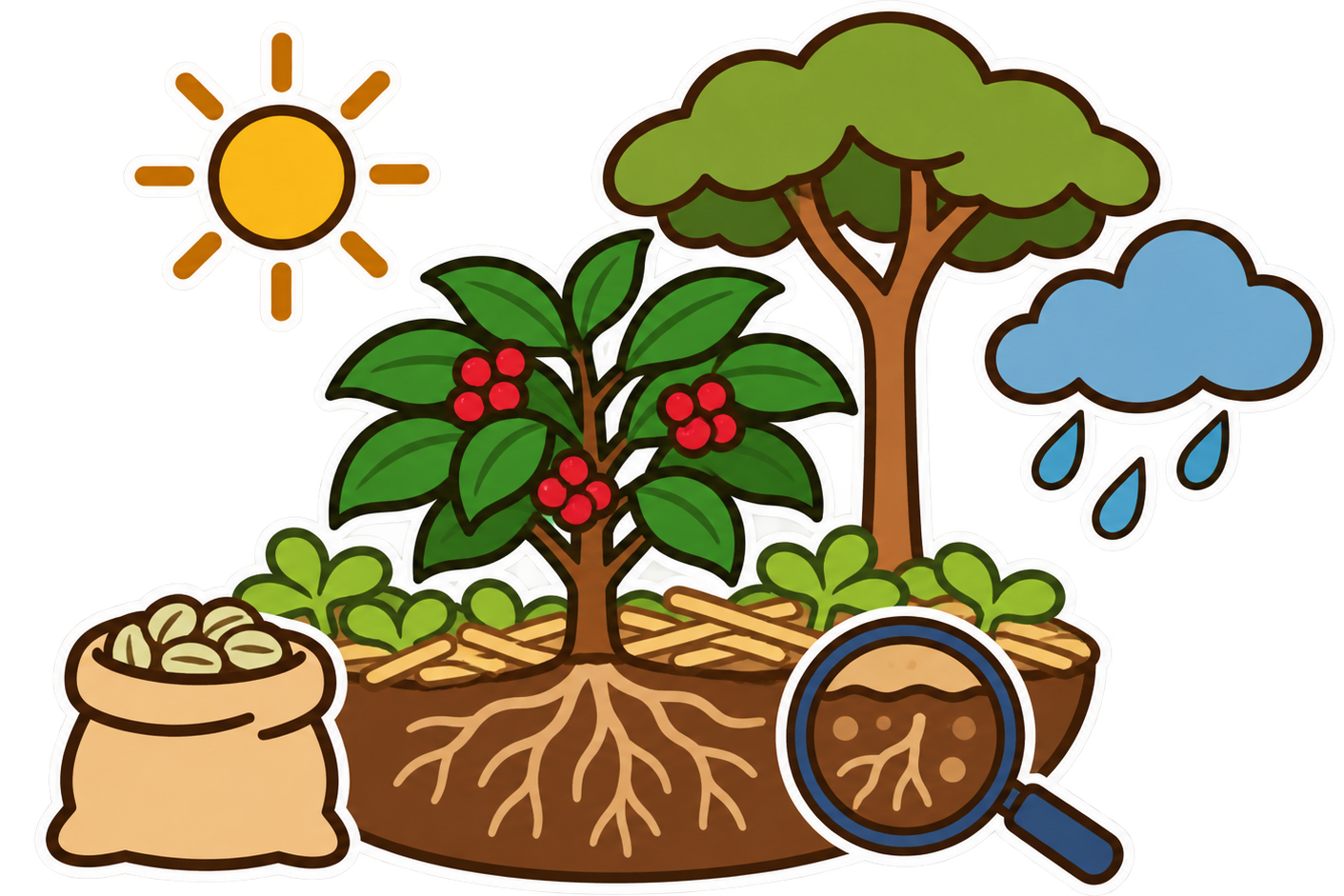
Given these conditions, the researcher argued that modern coffee farming can no longer rely solely on its three traditional pillars: irrigation, nutrition, and plant health. To maintain a productive and healthy coffee sector, he proposes developing a new set of essential strategies—such as establishing agroforestry systems, implementing soil cover, adopting innovative technologies, and expanding regenerative agriculture, among others.
Regenerative Agriculture
During her presentation, Farlla sought to answer another equally pivotal question in today’s context: why is regeneration an effective way to protect coffee from the climate? But first, she dispelled misconceptions about the subject—such as the notion that regenerative production necessarily entails adopting organic coffee farming or agroforestry systems. While these are important, she noted, they are not approaches that apply to every context.
According to the representative from Educampo, managing production indicators more effectively is also a form of regenerative practice. One example, she stated, is the use of cover crops, which has allowed many farms in the Cerrado Mineiro region to keep their soil covered and protected for much of the year. Another seemingly simple measure—creating forest corridors—can serve as an effective barrier against hail and frost, boosting productivity while potentially generating carbon credits for the producer.
To encourage such initiatives, Farlla highlighted the value of certifications—such as the Rainforest Alliance’s regenerative agriculture certification—as well as efforts to recognize producers who implement sustainable techniques on their farms. “The coffee of the future will not just be productive; it will be regenerative, transparent and connected to a purpose,” he declared, in the statement that concluded the debate.
The International Coffee Week (SIC) is organized by Espresso&CO, the Faemg Senar System, Sebrae, and the Government of the State of Minas Gerais, with institutional support from the Ocemg System. SIC features diamond-level sponsorship from 3corações Rituais; gold-level sponsorship from Anysort, Sicoob, and Senac in Minas; and bronze-level sponsorship from Nescafé and Yara. Supporting organizations include ABIC, Abics, IWCA Brasil, Banco do Brasil, BSCA, Cafés do Brasil, Cecafé, the Global Coffee Platform, and Sindicafé-MG. *Revista Espresso* and CaféPoint serve as the event’s official media partners.