
The Currency Paradox: Falling Futures, Firmer Brazilian Coffee Prices
Exchange Rate Paradox
The March 2027 Arabica coffee contract in New York closed this Friday, a national holiday in Brazil, at 268.50 c/lb, trading between 283.35 and 268.00 c/lb during the week, a range of 1,535 points. In November, the H7 contract has accumulated a decline of exactly 830 points, or -3.00%.
Physical coffee prices fluctuated sharply this week because of the dollar, with reports of trades between BRL 1,700.00 and BRL 1,800.00 for higher-quality coffees.
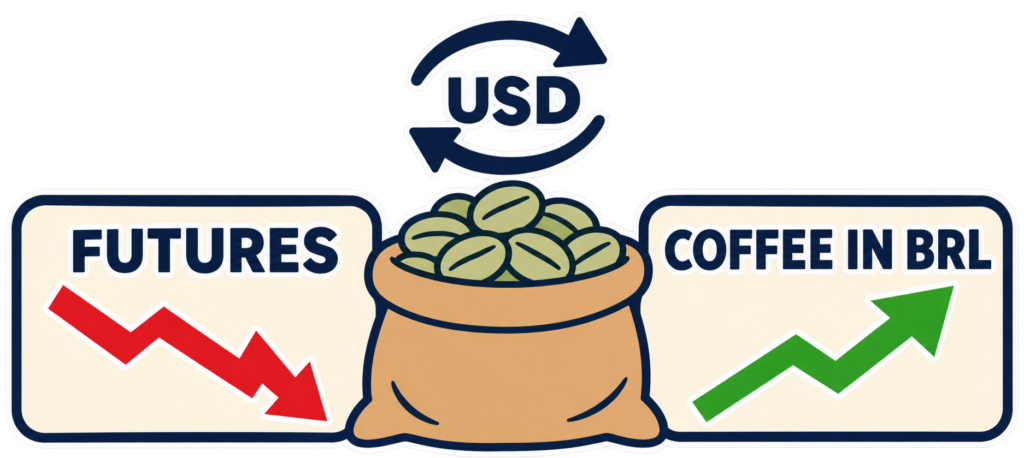
Large volumes of Arabica coffee have been arriving for exchange certification, with 251,230 bags pending, 100% Brazilian, in Antwerp. There is now more coffee pending certification than the current certified stock itself, which stands at 225,219 bags.
This has probably eased much of the pressure on the Z6/H7 spread and has kept the H7/K7 spread around +6.4 c/lb. The market has not yet returned to “normal,” but is closer to moving back into contango. The market has remained inverted for approximately three years.
Non-commercial funds remain net short, at their lowest level since November 2023 according to the disaggregated report. Could the normalization of global Arabica coffee supplies be causing funds to shift from net long to net short positions?
The January Robusta contract ended the week at USD 2,881/ton, with a high of USD 3,195 and a low of USD 2,854/ton. It has fallen more than 10% in November. Physical coffee prices dropped by around BRL 20.00, now quoted at BRL 900.00 per bag, also strongly supported by the sharp rise in the dollar.
Certified stocks currently stand at around 1 million bags. Robusta stocks have been recovering for longer than Arabica stocks, as the 2026/27 Arabica harvest was significantly delayed.
Non-commercial funds continue to sell Robusta aggressively, increasing their short position by 9,676 contracts. Over the past four weeks, they have sold around 25,000 contracts, contributing significantly to the decline in futures prices.
The dollar has been one of the main drivers of the coffee market in recent weeks. Since the second round of Brazil’s elections, the dollar has appreciated by approximately 19%, approaching BRL 6.00.
Some analysts are already projecting the dollar at around BRL 7.00. Such a sharp move in such a short period can change prices, margins, costs, and expectations.
On Thursday, the Central Bank held an auction to sell USD 1 billion in an attempt to contain the currency’s rise. The dollar temporarily fell from around BRL 5.93 to BRL 5.85, but the drop was short-lived, and by the end of the day it was back above BRL 5.93. The Central Bank’s intervention provided liquidity to the market but was not enough to reverse buying pressure.
This dollar movement is not limited to Brazil. The strengthening dollar is also putting pressure on other emerging-market currencies amid expectations of high U.S. interest rates, trade uncertainty, and greater risk aversion. In Brazil, fiscal concerns are adding further pressure on the real.
And what does all this have to do with coffee? Practically everything.
Coffee is a commodity traded internationally in dollars, so when the dollar rises, its value converted into Brazilian reais tends to increase even if its exchange price remains stable. This “feature” creates an interesting situation for Brazilian producers, particularly those who keep coffee in storage.
Without realizing it, many producers are practicing a kind of natural hedge. By holding physical coffee, they preserve an asset whose value in reais is exposed to the dollar, without needing to buy dollars, trade futures contracts, or use financial instruments to obtain currency protection.
It is not a perfect hedge because coffee remains exposed to exchange fluctuations, differentials, and supply-and-demand conditions. Holding coffee is not the same as holding dollars.
Recent Arabica performance illustrates this perfectly. The commodity lost value on the exchange, but the depreciation of the real offset that decline and helped lift physical coffee prices in Brazil. Producers see an increase in value when, in reality, that rise does not reflect an increase in coffee’s value but simply a loss of value in the real. It is a nominal appreciation that does not necessarily mean a real gain.
The other side of the story.
The same dollar that helps push up coffee prices per bag also directly affects production costs. Fertilizers, crop protection products, diesel, parts, equipment, agricultural machinery, and many other inputs used in coffee farming are directly or indirectly exposed to the dollar.
Brazil depends heavily on imported fertilizers, and when the dollar surges, that pressure quickly reaches input prices here in Brazil.
This means that higher coffee prices do not necessarily improve the terms of trade, meaning the number of bags needed to purchase a given quantity of fertilizers, crop protection products, or equipment.
An interesting figure appeared in the latest USDA report, published on November 16 using CEPEA data. In September 2026 alone, Brazilian producers needed 19.4% more coffee to buy the same quantity of fertilizer than in August. In other words, even with historically high coffee prices, the coffee-to-fertilizer exchange ratio deteriorated significantly in just one month.
So the nominal price per bag does not tell the whole story about real gains. What truly matters is how much a producer can buy with the value of one bag.
The situation becomes more delicate when we look at the production cycle. Coffee currently in storage was produced at the costs of a previous harvest, while the next crop will depend on inputs purchased under new exchange-rate conditions, with a higher dollar. Those who bought their inputs in advance may be in a favorable position, while those who still need fertilizers, crop protection products, or equipment may face significantly higher costs.
There is also the impact on credit. A weaker real, combined with fiscal concerns and inflation expectations, can put upward pressure on interest rates and make financing more expensive. For a crop that requires constant investment and has a long production cycle, the cost of money is just as important as the cost of inputs.
Another important aspect I see today is the volume of coffee still in producers’ hands.
Brazil has completed a huge crop, both Arabica and Conilon, and a considerable share of this coffee remains with producers. The strategy of holding coffee has been greatly supported by the high prices of recent years and by the financial strength of those who managed to come through previous harvests with good margins.
The USDA revised its estimate for Brazil’s 2026/27 crop upward, raising production from 71.9 to 72.5 million bags, including 49.2 million bags of Arabica and 23.3 million of Conilon. The revision reinforces expectations of greater Brazilian supply, with production 15% above the previous crop. The USDA projects Brazilian ending stocks at 3.42 million bags, a 49% increase over the previous cycle’s ending stocks. These figures indicate a recovery in available market supply.
This does not automatically mean lower prices. The market still faces weather uncertainties for the next 2027/28 crop, quality-related issues, and demand that remains strong. Increased supply does not eliminate the risk of supply shortages.
This situation deserves attention because holding coffee may work well for individual producers but lead to different consequences when viewed collectively.
Better-capitalized producers can manage their sales, while the market faces potential supply that could emerge in moments of financial need, shifting expectations, or commercial opportunities such as the current dollar rally. There is an interesting contradiction here: a higher dollar can encourage coffee sales in Brazil precisely because it improves conversion into reais, but if those sales increase substantially, they may put downward pressure on the New York and London exchanges, reducing part of the currency benefit that encouraged the sales in the first place.
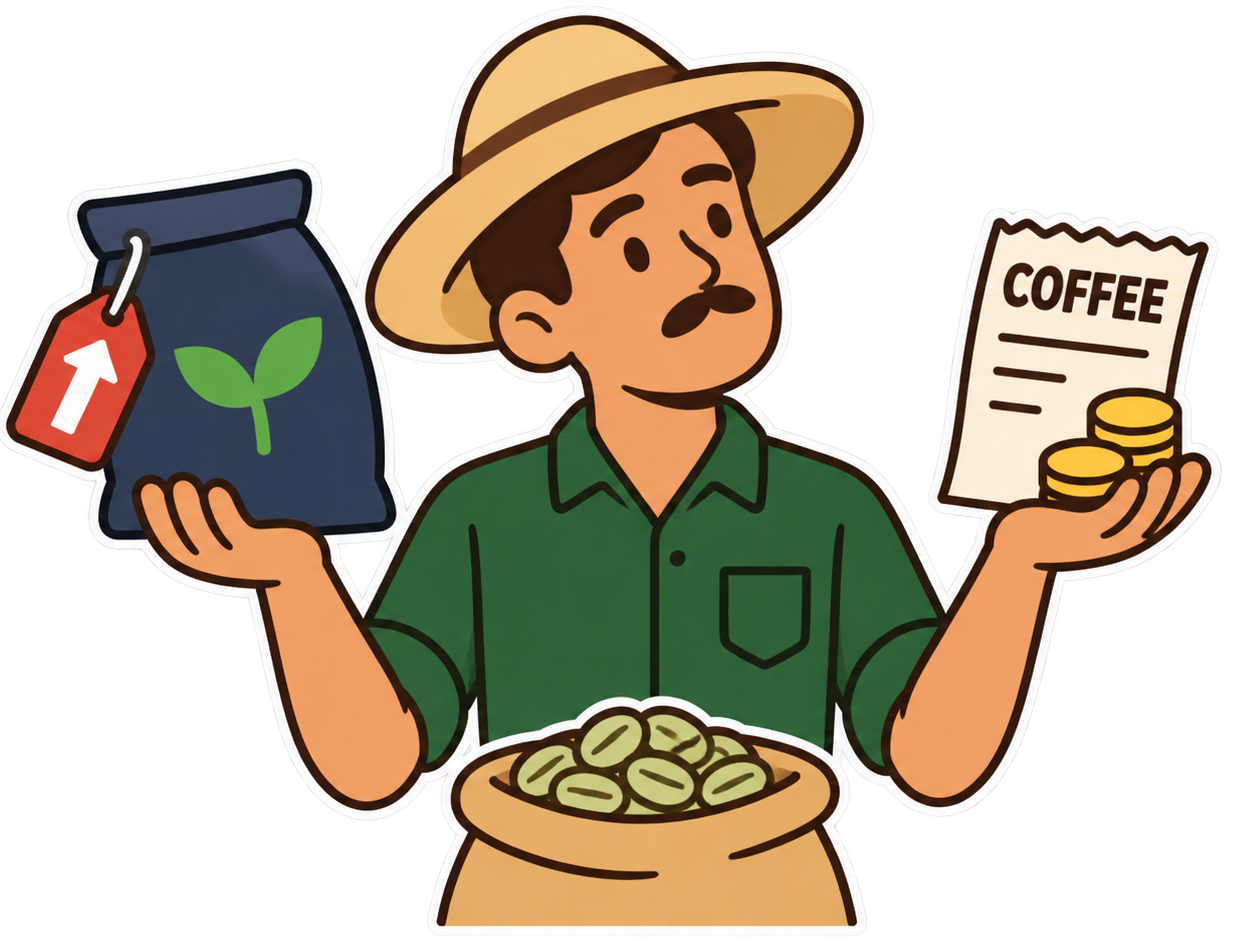
A stronger dollar encourages coffee sales, and those sales can end up pushing coffee prices themselves lower. Interesting, isn’t it?
I am not saying coffee is expensive or cheap, much less that producers should sell or continue holding. I am saying that markets have mechanisms that often produce outcomes opposite to what we expect.
This dynamic becomes even more interesting when we consider the global financial environment. High government debt, persistently high interest rates, and liquidity risks are raising concerns about global economic stability. The IMF (International Monetary Fund) itself has warned that, despite the resilience of the financial system, vulnerabilities remain that could intensify periods of risk aversion.
I am not predicting a global financial collapse like the one in 2008, but we cannot ignore that possibility. In a crisis, investors may seek safety in the dollar while simultaneously liquidating positions in commodities.
Imagine the dollar surging while coffee futures fall enough to wipe out the dollar’s positive effect on physical coffee prices. At the same time, input costs keep rising, credit becomes tighter, and the need for liquidity increases.
Complicated, isn’t it? But possible.
It is in moments like these that stored coffee ceases to be merely a form of asset protection and becomes a financial decision as well, involving opportunity cost, storage, tied-up capital, and market exposure.
For well-capitalized producers who know their costs and can manage their financial needs, holding coffee can be an extremely effective commercial strategy. Nominal appreciation should not be confused with a real increase in wealth.
A producer’s true profitability depends not only on the price per bag, but on the relationship between revenue, costs, productivity, and the purchasing power they can preserve over time.
The dollar can protect part of the value of stored coffee while making everything needed to produce the next crop more expensive. It can improve export revenue while also fueling inflation.
This may be an especially important time for producers to look beyond the nominal price per bag and assess their assets, future obligations, and terms of trade.
Producers usually know exactly how much they have gained by holding their coffee. But do they pay the same attention to how much purchasing power they have lost when it comes to producing the next crop?
The dollar can give with one hand and take away with the other.
By Gustavo Matias | 22 November 2026